
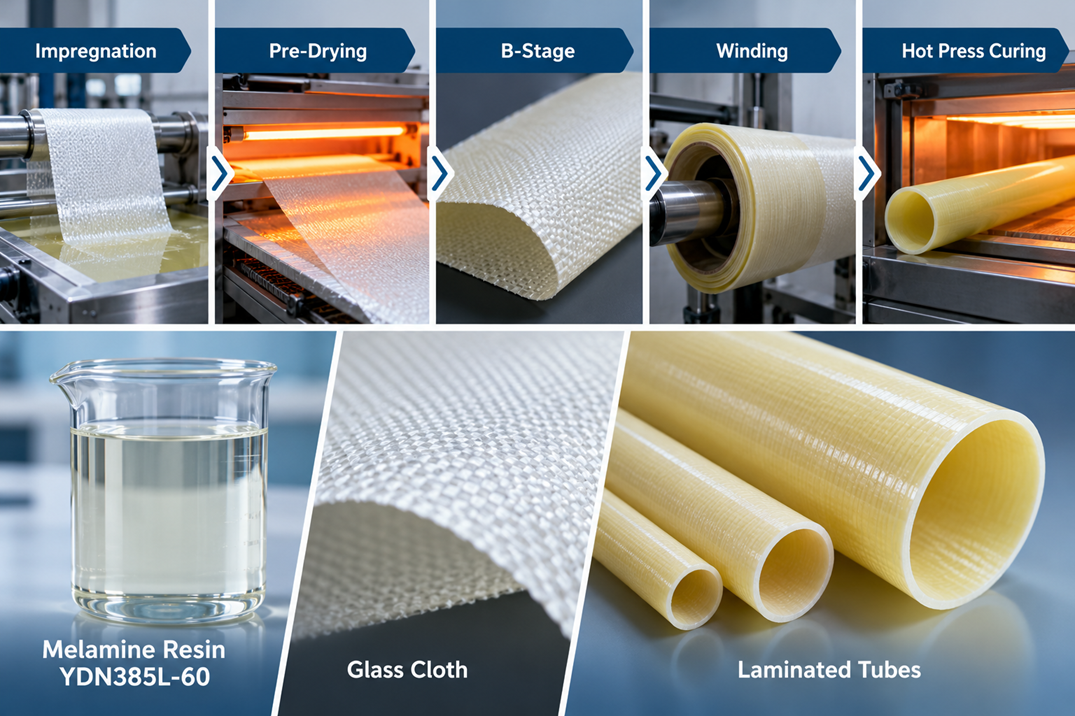
Melamine Resin for Glass Cloth Laminated Tubes: Impregnation, B-Stage and Hot Pressing
Glass cloth laminated tubes are fiber-reinforced thermosetting composites manufactured through resin impregnation, drying, B-stage processing, winding and final curing. Melamine-formaldehyde resin can be used as the matrix in certain electrical insulation laminate systems. Key processing variables include resin viscosity, solids content, resin pick-up, prepreg condition and curing behavior. YDNRESIN YDN385L-60 is a low-viscosity water-soluble modified melamine resin with solids content ≥58% and viscosity of 30–100 mPa·s at 30°C. It may be evaluated for glass cloth impregnation and laminated tube development, subject to process trials and finished-product testing.
Melamine Resin for Glass Cloth Laminated Tubes: Impregnation, B-Stage and Hot Pressing
A Technical Guide to Resin Selection, Glass Fabric Impregnation, Pre-Curing, Tube Winding and Final Curing
Quick Answer: What Resin Is Used in Glass Cloth Laminated Tubes?
Glass cloth laminated tubes are fiber-reinforced thermosetting composite materials manufactured through resin impregnation, drying, partial curing, winding and final curing.
Melamine-formaldehyde resin is one of the thermosetting resin systems used in certain electrical insulation glass cloth laminates and tubes.
For these applications, suitable resin viscosity, solids content, glass fiber wetting, B-stage control and final curing conditions are important factors affecting processing consistency and finished-product properties.
YDNRESIN YDN385L-60, a low-viscosity water-soluble modified melamine resin with solids content ≥58% and viscosity of 30–100 mPa·s at 30°C, may be evaluated as a candidate impregnation resin for glass cloth laminated tube development.
Final suitability depends on the complete formulation, manufacturing process and finished-product testing.
- What Are Melamine Glass Cloth Laminated Tubes?
Melamine glass cloth laminated tubes are thermosetting composite structures manufactured using woven glass fabric as reinforcement and melamine-formaldehyde resin as the polymer matrix.
During manufacturing, the resin impregnates the glass fabric and subsequently undergoes a curing reaction to form a crosslinked thermosetting structure.
The glass fabric provides reinforcement, while the cured resin contributes to fiber bonding, structural integrity and other properties of the finished laminate.
Depending on the laminate design and applicable performance requirements, these materials may be developed for:
- Electrical insulation tubes and sleeves
- Insulating support components
- Tubular insulating structures for electrical equipment
- Glass fiber-reinforced thermosetting components
- Specialized industrial insulation applications
Different applications may require different resin chemistries, including melamine, epoxy or phenolic systems.
The appropriate resin must be selected according to the required electrical, mechanical, thermal and environmental performance.
- Manufacturing Process of Glass Cloth Laminated Tubes
A typical prepreg-based manufacturing process can be described as:
Glass Cloth Preparation → Resin Impregnation → Resin Pick-Up Control → Pre-Drying → B-Stage → Tube Winding → Final Curing → Machining and Inspection
Specific production methods may differ depending on the winding equipment, tube dimensions, pressure application and curing technology.
Each processing stage influences how the resin behaves within the glass fabric structure.
2.1 Glass Cloth Preparation
Glass fabric is the reinforcement material used to construct the laminated tube.
Important substrate characteristics include:
- Fabric weight
- Fabric thickness
- Weave construction
- Yarn density
- Fiber bundle structure
- Surface treatment
- Sizing or coupling-agent compatibility
Dense woven glass fabrics may require more careful impregnation control because the resin must penetrate the spaces between individual fibers and fiber bundles.
A resin that performs well with one type of glass fabric may require different processing conditions when used with another fabric construction.
2.2 Resin Impregnation
Resin impregnation is intended to distribute the thermosetting resin throughout the glass fabric.
Effective impregnation should minimize:
- Dry fiber regions
- Incomplete penetration
- Uneven resin distribution
- Local resin-rich areas
- Entrapped air
For water-soluble melamine resin systems, important processing variables include resin viscosity, solids content, bath temperature, impregnation speed and fabric construction.
Lower viscosity can facilitate resin flow into fiber bundles under suitable wetting conditions.
However, excessively low viscosity may increase resin drainage and make resin retention more difficult to control.
The objective is not the lowest possible viscosity, but a suitable impregnation window.
2.3 Resin Pick-Up Control
Resin pick-up affects the amount of polymer matrix remaining in the glass fabric after drying.
Insufficient resin retention may contribute to incomplete fiber bonding, internal defects or poor interlaminar performance.
Excessive resin content may create additional challenges during drying, winding and curing.
Manufacturers should distinguish between wet resin pick-up and dry resin content.
The final dry resin content should be evaluated together with the reinforcement structure and target laminate properties.
- What Is B-Stage in Melamine Resin Impregnation?
B-stage refers to a partially reacted state of a thermosetting resin before final curing.
For suitable prepreg manufacturing systems, the impregnated fabric is dried and partially advanced to obtain sufficient handling and processing stability while retaining the ability to undergo further curing.
In glass cloth laminated tube production, B-stage control influences prepreg flexibility, winding behavior and final interlayer bonding.
3.1 What Happens When B-Stage Is Insufficient?
Insufficient drying or reaction advancement may result in:
- Excessive prepreg tackiness
- Unstable winding behavior
- High residual moisture or volatile content
- Resin redistribution during handling
- Voids or bubbles during subsequent heating
These risks depend on the specific resin chemistry and processing conditions.
3.2 What Happens When B-Stage Is Excessive?
Over-advancement may reduce the remaining resin flow and its ability to develop satisfactory interlayer contact during final curing.
Possible consequences include:
- Reduced prepreg flexibility
- Difficulties during tube winding
- Insufficient resin flow during consolidation
- Increased risk of interlaminar defects
The appropriate B-stage window must be established experimentally for each resin formulation and manufacturing process.
3.3 How Can B-Stage Be Controlled?
Key variables include:
- Resin formulation and catalyst system
- Resin solids and dry resin content
- Drying temperature
- Oven residence time
- Glass fabric thickness
- Residual volatile content
- Prepreg flexibility and handling characteristics
- Final curing response
Residual volatile measurements, flow evaluation, thermal analysis and trial tube manufacturing can help establish the processing window.
Key principle: B-stage control should balance prepreg handling stability with sufficient remaining flow and reactivity for final curing.
- How Does Melamine Resin Affect Glass Cloth Tube Winding?
During tube winding, the prepared glass cloth is wrapped around a mandrel to form a multilayer tubular structure.
Resin distribution and prepreg condition influence the stability of this process.
Prepreg Flexibility
The prepreg must accommodate the intended winding diameter without unacceptable cracking or damage.
Excessive pre-curing may reduce flexibility and complicate winding.
Resin Tack and Handling
Excessive tack can make handling difficult, while insufficient interlayer contact can affect winding stability.
The preferred tack level depends on the specific production method.
Winding Tension
Inappropriate tension may result in wrinkles, local fiber distortion or uneven consolidation.
Resin Distribution
Uneven resin content may cause local variations in thickness, flow or final laminate quality.
Tube Dimensions
Different diameters, wall thicknesses and laminate constructions may require different winding and curing conditions.
For these reasons, resin selection should consider not only the liquid resin properties but also the behavior of the impregnated fabric during actual tube manufacturing.
- Hot Pressing and Final Curing of Glass Cloth Laminated Tubes
After winding, the thermosetting resin must complete its curing reaction under conditions appropriate for the selected manufacturing route.
Depending on the production method, the process may involve controlled heating, pressure or other suitable consolidation and curing techniques.
5.1 Resin Flow During Heating
Certain partially cured thermosetting resin systems may exhibit additional flow before developing their final crosslinked structure.
Appropriate flow can help improve interlayer contact.
However, excessive resin migration may result in uneven resin distribution or localized resin depletion.
The curing cycle must therefore be matched to the resin formulation and prepreg condition.
5.2 Pressure and Consolidation
Suitable processing pressure may help improve layer contact and reduce some internal voids.
Excessive or poorly timed pressure may cause resin squeeze-out or other defects.
The optimum pressure depends on resin flow, tube structure and the manufacturing equipment.
5.3 Final Curing and Product Performance
Incomplete curing can affect the mechanical and electrical performance of a finished laminate.
At the same time, unsuitable thermal conditions may cause internal stresses, deformation or defects.
Manufacturers should evaluate finished tubes according to the relevant application requirements, including:
- Degree of cure
- Interlaminar bonding
- Dimensional stability
- Electrical insulation properties
- Mechanical strength
- Moisture absorption
- Thermal performance
Specific curing temperatures, pressures and durations must be established through formulation-specific process trials.
Conditions developed for epoxy or phenolic systems should not automatically be transferred to melamine resin systems.
- Common Glass Cloth Lamination Problems and Troubleshooting
Glass cloth laminated tube defects may arise from the resin, reinforcement, impregnation equipment, drying conditions, winding or final curing.
The following table summarizes common troubleshooting directions.
| Problem | Possible Causes | What to Check |
| Dry spots | Poor wetting, dense weave, insufficient impregnation | Viscosity, fabric treatment, impregnation speed |
| Uneven resin pick-up | Unstable metering or bath conditions | Rollers, solids content, bath temperature |
| Internal bubbles | Residual moisture, volatiles, entrapped air | Drying profile, volatile content, heating cycle |
| Delamination | Incomplete impregnation, unsuitable B-stage or cure | Prepreg condition, winding and curing process |
| Resin-rich areas | Uneven metering or resin migration | Pick-up control, pressure and resin flow |
| Tube deformation | Winding tension, cure shrinkage or cooling issues | Mandrel, tension, curing and cooling |
These are potential causes rather than confirmed diagnoses.
Reliable troubleshooting requires evaluating the complete system: resin + glass fabric + impregnation + drying + winding + curing.
Changing the resin grade alone may not resolve every production defect.
- YDN385L-60: Low-Viscosity Melamine Resin for Impregnation Evaluation
YDNRESIN supplies the YDN385 series of water-soluble modified melamine resins for industrial formulation and processing applications.
Within this series, YDN385L-60 is a low-viscosity grade that may be evaluated for applications requiring improved liquid flow and penetration into fibrous substrates.
7.1 YDN385L-60 Technical Specifications
| Parameter | YDN385L-60 |
| Resin Type | Water-soluble modified melamine resin |
| Solids Content | ≥58% |
| Viscosity at 30°C | 30–100 mPa·s |
| pH | 8–10 |
| Free Formaldehyde | ≤0.7% |
| Water Solubility | Clear |
| Stability | ≥8 hours |
These values are reference specifications from currently published product information. Applicable technical data sheets and actual supply specifications should be consulted for confirmation. The stated stability parameter is not a guarantee of usable pot life under every production condition.
7.2 Why Evaluate YDN385L-60 for Glass Cloth Laminated Tubes?
Low Initial Viscosity
The viscosity range of 30–100 mPa·s at 30°C offers a starting point for evaluating resin penetration into woven glass fabric.
Water-Soluble Resin System
Its water solubility supports evaluation in compatible aqueous processing systems, subject to fabric treatment and formulation requirements.
Potential for Impregnation Process Development
YDN385L-60 may be investigated for resin pick-up control, drying behavior, B-stage development, winding performance and final cure response.
However, low viscosity and water solubility alone do not establish suitability for a particular electrical laminate specification.
Final performance must be demonstrated experimentally.
7.3 Does YDN385L-60 Meet NEMA G5 or G9 Requirements?
Compliance cannot be determined from liquid resin properties alone.
G5 and G9 are associated with specified glass fabric-reinforced melamine laminate material classifications.
Applicable requirements concern finished laminate construction and performance rather than the resin grade in isolation.
YDN385L-60 may be considered for evaluation in related laminate development, but this does not constitute a claim of G5/G9 compliance or certification.
- How to Evaluate YDN385L-60 for Glass Cloth Tube Manufacturing
A structured evaluation program can help determine whether a candidate resin is suitable for a specific manufacturing process.
Step 1: Define the Reinforcement and Tube Construction
Identify fabric weight, weave, surface treatment, target tube diameter, wall thickness and end-use application.
Step 2: Establish the Impregnation Window
Evaluate bath viscosity, solids content, fabric wetting, resin penetration and dry resin pick-up.
Step 3: Optimize Drying and B-Stage
Compare drying profiles and measure relevant prepreg characteristics, including residual volatiles, flexibility and final curing behavior.
Step 4: Conduct Winding and Curing Trials
Use representative equipment and processing conditions to evaluate tube formation, consolidation and curing.
Step 5: Test Finished Tube Properties
Perform appropriate mechanical, electrical, thermal, moisture-related and dimensional tests according to end-use requirements.
The resin should be approved for production only after its suitability has been demonstrated under relevant manufacturing conditions.
- Frequently Asked Questions
What type of resin is used for glass cloth laminated tubes?
Glass cloth laminated tubes can be manufactured using melamine, epoxy, phenolic or other thermosetting resin systems. The correct choice depends on processing requirements and the target electrical, mechanical, thermal and environmental properties.
Is low-viscosity melamine resin better for glass cloth impregnation?
Lower viscosity can improve resin penetration under appropriate conditions, but it is not automatically better. Resin solids, fabric structure, drainage, dry resin content and curing behavior must also be considered.
What is B-stage in melamine resin processing?
B-stage is a partially reacted thermosetting resin state before final curing. In suitable prepreg processes, it provides handling and forming capability while retaining sufficient reactivity for subsequent curing.
Why do glass cloth laminated tubes develop bubbles or delamination?
Bubbles may be associated with moisture, volatiles or entrapped air. Delamination may result from incomplete impregnation, unsuitable prepreg condition, poor interlayer contact or insufficient curing. The full manufacturing process should be reviewed.
Can YDN385L-60 be used for glass cloth laminated tubes?
YDN385L-60 may be evaluated as a candidate impregnation resin. Its solids content of ≥58% and viscosity of 30–100 mPa·s at 30°C provide a technical starting point, but suitability requires impregnation, B-stage, winding, curing and finished-product testing.
Is YDN385L-60 certified for NEMA G5 or G9 laminates?
No certification or compliance conclusion should be inferred from the resin specifications presented here. G5/G9-related compliance must be determined through the applicable finished-material requirements and testing.
- Conclusion: Resin Selection Must Support the Complete Manufacturing Process
Glass cloth laminated tube manufacturing involves much more than selecting a low-viscosity resin.
The process requires coordinated control of:
- Glass fabric wetting and penetration
- Resin pick-up and distribution
- Pre-drying and B-stage
- Winding and interlayer contact
- Final consolidation and curing
- Finished-product performance
For manufacturers developing melamine-based glass cloth laminated tubes, YDN385L-60 offers a low-viscosity, water-soluble candidate resin for technical evaluation.
Its actual suitability should be confirmed using the manufacturer’s reinforcement materials, processing equipment and performance requirements.
Technical Support and Sample Evaluation
Are you developing glass cloth laminated tubes, electrical insulation sleeves or related thermosetting composite products?
Please share the following details with the YDNRESIN technical team:
- Glass fabric specifications and surface treatment
- Target tube dimensions and end-use application
- Current resin system
- Target dry resin content
- Impregnation and drying conditions
- Winding and final curing process
- Required electrical, mechanical or thermal properties
Our team can discuss suitable resin evaluation options, including YDN385L-60, and potential sample testing arrangements.
YDNRESIN – Industrial Melamine Resin & Amino Resin Solutions
Website: https://www.ydnresin.com