
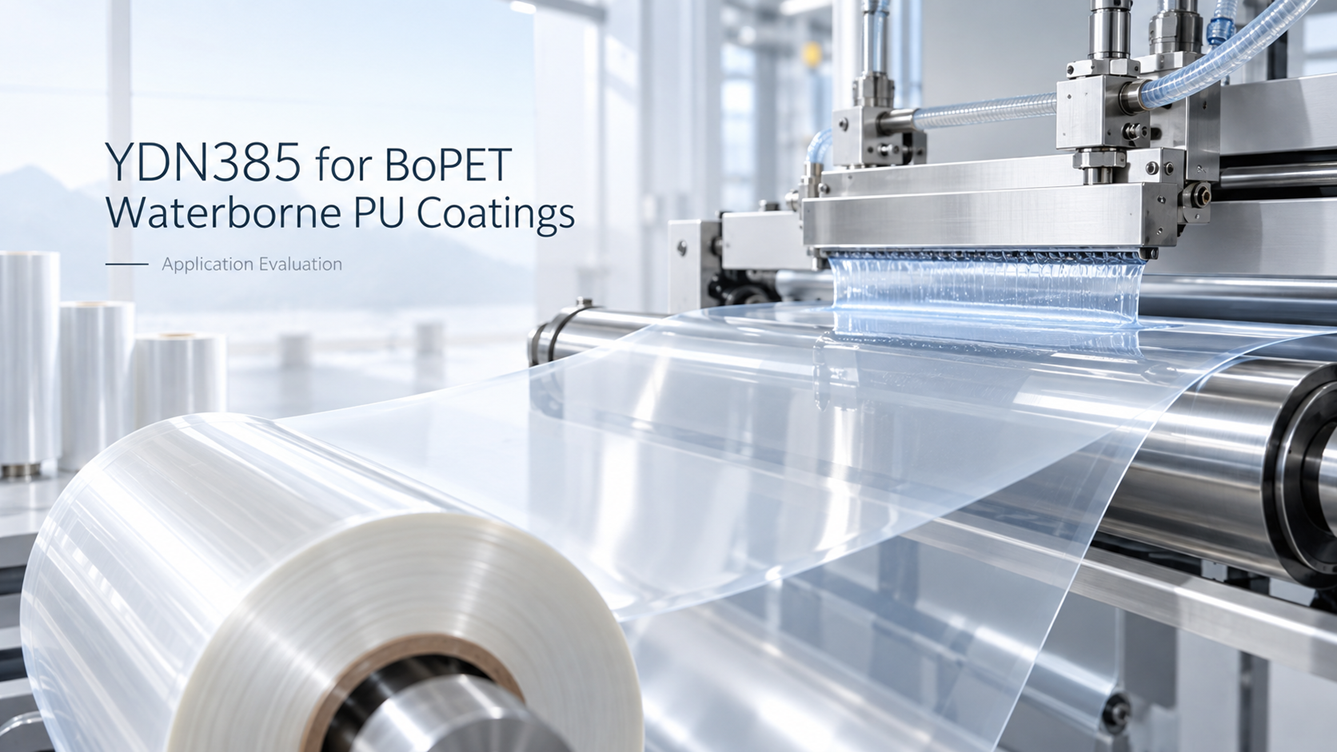
YDN385 for BoPET Waterborne PU Coatings: Application and Crosslinking Evaluation
What is YDN385?
YDN385 is a high-imino, water-soluble melamine crosslinker developed for waterborne coating systems. It can be evaluated with waterborne polyester, acrylic, and selected polyurethane-based formulations.
Can YDN385 be used in BoPET film coatings?
YDN385 can be considered as a candidate crosslinker for BoPET functional coatings, with evaluation focused on adhesion, chemical resistance, film hardness, flexibility, and thermal processing stability.
Why Crosslinking Matters in BoPET Film Coatings
BoPET, or biaxially oriented polyethylene terephthalate film, is widely used in:
- Flexible packaging
- Labels
- Industrial films
- Printing substrates
- Functional films
- Laminates
- Electronic and specialty film applications
It offers a useful combination of mechanical strength, dimensional stability, transparency, heat resistance, and processability.
As waterborne coating technologies continue to develop, waterborne polyester, acrylic, and polyurethane systems are increasingly used for PET and BoPET surface applications.
In these systems, the base resin determines much of the fundamental film-forming behavior, while the crosslinking system can further influence the final coating structure and performance.
Depending on the application, formulators may need to balance several properties at the same time:
- Adhesion to PET
- Cohesive strength
- Water resistance
- Solvent resistance
- Chemical resistance
- Surface hardness
- Flexibility
- Heat resistance
- Stability during high-temperature processing
For this reason, crosslinker selection should be treated as part of the overall coating design rather than as an isolated raw-material decision.
Crosslinking in Waterborne Polyester PU Systems
Waterborne polyester polyurethane systems can combine the flexibility of polyurethane chemistry with the performance characteristics associated with polyester structures.
In applications requiring higher levels of chemical resistance, hardness, heat resistance, or durability, an additional crosslinking system may be considered.
High-imino melamine crosslinkers are one option that can be evaluated for this purpose.
Under suitable formulation and curing conditions, they can participate in the development of a more highly crosslinked coating network.
However, higher crosslink density does not automatically mean better overall performance.
For flexible substrates such as BoPET, excessive crosslinking may negatively affect:
- Flexibility
- Bend resistance
- Lamination behavior
- Post-processing performance
The objective is therefore not to maximize crosslink density, but to achieve the right balance between resistance, hardness, adhesion, and flexibility.
What Is a High-Imino Melamine Crosslinker?
High-imino melamine resins belong to the broader family of amino resin crosslinkers.
Their behavior in a coating system depends on multiple formulation variables, including:
- Base resin chemistry
- Reactive functional groups
- Solids content
- pH
- Catalyst system
- Crosslinker dosage
- Curing temperature
- Curing time
Potential systems for evaluation may include:
- Waterborne polyester
- Waterborne acrylic
- Selected waterborne polyurethane systems
- Polymers containing hydroxyl functionality
- Polymers containing carboxyl functionality
- Other waterborne coating systems with suitable reactive functionality
The product category alone does not determine final performance.
Actual results must be evaluated within the complete formulation.
YDN385: Product Positioning
YDN385 is a high-imino, water-soluble melamine crosslinker developed for waterborne applications.
Its application development areas include:
- Waterborne polyester coatings
- Waterborne acrylic coatings
- Selected waterborne polyurethane systems
- Industrial waterborne coatings
- Textile finishing
- Functional waterborne coatings
For BoPET applications, YDN385 is best positioned as:
A candidate high-imino melamine crosslinker for formulation development in waterborne functional coating systems.
Its suitability should be determined according to the specific binder chemistry, processing conditions, and target performance requirements.
Key Evaluation Areas for YDN385 in BoPET Coatings
- Adhesion to PET
Adhesion is often one of the most important performance criteria in BoPET coating applications.
A properly designed crosslinking system may influence coating cohesion and durability, but adhesion to PET is not controlled by the crosslinker alone.
Other important factors can include:
- PET surface condition
- Corona treatment
- Plasma treatment
- Primer selection
- Binder polarity
- Coating thickness
- Drying conditions
- Curing conditions
For this reason, YDN385 should always be evaluated as part of the complete coating system.
- Chemical Resistance
Functional film coatings may be exposed to:
- Water
- Alcohol
- Cleaning agents
- Oils
- Solvents
- Application-specific chemicals
A suitable crosslinking system can be used to adjust coating resistance to these media.
The actual effect will depend on the base polymer, formulation balance, and curing conditions.
Testing should therefore be designed around the real end-use environment.
- Film Hardness
Introducing a crosslinker can change the internal network structure of the coating and may affect film hardness.
For flexible PET or BoPET films, however, maximum hardness should not be the only objective.
Hardness should be evaluated together with:
- Adhesion
- Flexibility
- Bend resistance
- Lamination behavior
- Downstream processing performance
The preferred formulation is the one that provides the required overall balance.
- Flexibility
BoPET is a flexible film substrate.
If a coating becomes excessively crosslinked, possible issues may include:
- Brittleness
- Cracking during bending
- Reduced flexibility
- Lower adhesion after deformation
- Poorer downstream converting performance
Flexibility should therefore be evaluated together with hardness and chemical resistance during formulation development.
- Thermal Processing Stability
Some BoPET coating and downstream processing operations may involve elevated temperatures.
Under higher-temperature conditions, evaluation should extend beyond simple curing behavior.
Important observations may include:
- Color change
- Yellowing
- Brittleness
- Gloss loss
- Surface defects
- Adhesion changes
- Performance retention after heat exposure
It is also important to distinguish between:
Oven set temperature
and
Actual peak substrate temperature
These values may differ significantly.
For high-temperature coating processes, both the actual substrate temperature and residence time should be considered during testing.
How Should YDN385 Be Evaluated?
For an established coating formulation, a controlled A/B comparison is generally more useful than immediately replacing the entire crosslinking system.
Reference Formulation
Existing binder
+
Current crosslinking system
Evaluation Formulation
Same binder
+
YDN385
Other formulation and process variables should remain as consistent as possible.
Recommended evaluation items include:
| Test Item | Evaluation Purpose |
| PET Adhesion | Evaluate bonding between coating and substrate |
| Cross-Cut Adhesion | Compare adhesion classification |
| Chemical Resistance | Evaluate resistance to selected media |
| Pencil Hardness | Monitor changes in film hardness |
| Flexibility | Identify brittleness or loss of flexibility |
| Bend Resistance | Evaluate performance during film deformation |
| Heat Aging | Evaluate stability after thermal exposure |
| Appearance | Check for yellowing, gloss loss, craters, or other defects |
| Formulation Stability | Evaluate storage and processing stability |
This approach is generally more meaningful than comparing technical data sheets alone.
Final coating performance is the result of the interaction between:
Binder + Crosslinker + Catalyst + Formulation Ratio + Curing Conditions
How Should YDN385 Dosage Be Determined?
There is no single crosslinker dosage that can be applied to every waterborne polyester or polyurethane formulation.
The appropriate level depends on:
- Binder solids content
- Hydroxyl functionality
- Carboxyl functionality
- Polymer structure
- Catalyst system
- Target crosslink density
- Curing conditions
- Final performance requirements
For formulation development, a dosage ladder is generally more appropriate than selecting one fixed level.
For example:
Lower level → Medium level → Higher level
Each level can then be evaluated for:
- Adhesion
- Chemical resistance
- Hardness
- Flexibility
- Thermal stability
- Film appearance
The dosage range can then be narrowed based on actual test results.
Why the Catalyst System Also Matters
The curing behavior of melamine crosslinking systems can be strongly influenced by catalytic conditions.
Formulators may need to evaluate:
- Whether a catalyst is required
- Catalyst type
- Catalyst dosage
- Formulation pH
- Storage stability
- Pot life
- Cure temperature
- Cure time
Insufficient catalytic activity may result in incomplete curing.
Excessive catalytic activity may reduce formulation stability or create an overly narrow processing window.
For this reason:
The crosslinker and catalyst system should be optimized together.
What Information Is Useful Before Formulation Testing?
To improve the efficiency of crosslinker evaluation, the following information is useful before testing begins.
Binder Information
- Resin type
- Technical data sheet
- Solids content
- Viscosity
- pH
Functional Group Information
Where available:
- Hydroxyl value
- Acid value
- Carboxyl functionality
- Other reactive functional groups
Current Crosslinking System
- Current crosslinker type
- Current dosage
- Catalyst type
- Catalyst dosage
Processing Conditions
- Oven temperature
- Actual peak substrate temperature
- Residence time
- Coating weight
- Dry film thickness
Target Performance
For example:
- Adhesion requirement
- Water resistance
- Alcohol resistance
- Solvent resistance
- Film hardness
- Flexibility
- Heat resistance
These parameters help determine whether YDN385 is suitable for further formulation evaluation.
Why Formulation Matching Matters More Than Product Matching
The final performance of an industrial coating is not determined by one raw material alone.
Even when two crosslinkers belong to a similar chemical category, changes in any of the following variables can affect the final result:
- Binder chemistry
- Reactive functionality
- Crosslinker dosage
- Catalyst
- pH
- Cure temperature
- Cure time
- Film thickness
A more reliable development process is therefore:
Define Application Requirements
↓
Select Candidate Crosslinker
↓
Laboratory Formulation Testing
↓
Performance Comparison
↓
Optimize Dosage and Curing Conditions
↓
Pilot Validation
↓
Production Validation
This approach provides a more reliable basis for material selection than a simple commercial product cross-reference.
Potential Application Areas for YDN385
Based on its positioning as a water-soluble high-imino melamine crosslinker, YDN385 can be evaluated for applications including:
- BoPET functional film coatings
- PET film primers
- Waterborne polyester coatings
- Selected waterborne PU coatings
- Waterborne acrylic coatings
- Flexible packaging functional coatings
- Industrial waterborne coatings
- High-temperature cured functional coatings
- Textile finishing
Final suitability should always be verified according to the actual binder system, curing process, and performance requirements.
Is YDN385 Suitable for Your Formulation?
For BoPET, waterborne polyester, waterborne polyurethane, or other functional coating projects, the following six points should first be confirmed:
- Binder type
- Binder solids content
- Reactive functional groups
- Current crosslinking system
- Curing temperature and time
- Target performance requirements
Once these parameters are known, YDN385 can be evaluated more effectively as a candidate crosslinker.
This approach is generally more reliable than selecting a material based only on a commercial product name.
Frequently Asked Questions
What type of product is YDN385?
YDN385 is a high-imino, water-soluble melamine crosslinker developed primarily for waterborne coating applications.
Can YDN385 be used with waterborne polyurethane?
YDN385 can be evaluated with selected waterborne polyurethane and waterborne polyester polyurethane systems.
Suitability depends on:
- Binder chemistry
- Reactive functional groups
- Solids content
- Catalyst system
- Curing conditions
Can YDN385 be used in BoPET film coatings?
YDN385 can be evaluated as a candidate crosslinker for BoPET functional coatings.
Key performance areas should include:
- PET adhesion
- Chemical resistance
- Film hardness
- Flexibility
- Thermal stability
- Coating appearance after heat exposure
Is a higher melamine crosslinker dosage always better?
No.
Insufficient crosslinking may limit resistance and hardness, while excessive crosslinking may reduce flexibility or increase brittleness.
The appropriate dosage should be determined through controlled formulation testing.
Does a higher curing temperature always improve crosslinking?
No.
Higher temperature may promote curing in some systems, but excessive temperature or residence time may also contribute to:
- Yellowing
- Brittleness
- Surface defects
- Substrate deterioration
The curing window should therefore be optimized for the actual formulation and process.
Can poor PET adhesion be solved only by changing the crosslinker?
Not necessarily.
PET adhesion can also be strongly influenced by:
- Surface treatment
- Binder chemistry
- Primer selection
- Coating polarity
- Film thickness
- Curing conditions
Poor adhesion should therefore be investigated from the perspective of the complete coating system.
About YDNRESIN
YDNRESIN develops and supplies melamine resins and related crosslinking materials for applications including:
- Industrial coatings
- Waterborne coatings
- Textile finishing
- Flexible packaging
- Film coatings
- Specialty functional materials
Rather than relying only on commercial product cross-references, YDNRESIN focuses on matching crosslinker selection with the actual binder chemistry, processing conditions, and target performance of each formulation.
For BoPET film, waterborne polyester, waterborne polyurethane, and other functional coating systems, YDN385 can be evaluated according to the specific resin system, curing conditions, and application requirements.